

Tempranillo: Spain’s Backbone Grape Across the World
- Posted on
- Posted in spain, tempranillo
- 0
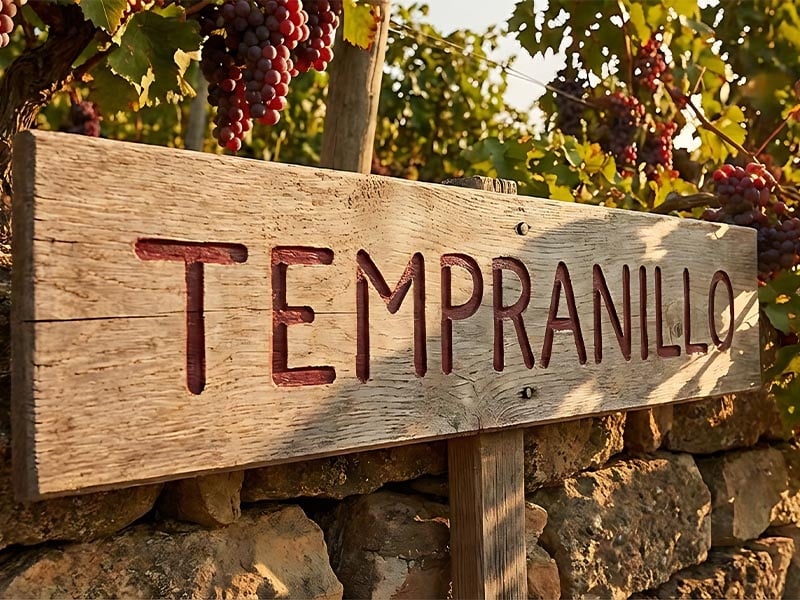
Spanish cultivation of Vitis vinifera, the common ancestor of almost all vines in existence today, began in earnest with Phoenician settlements in the southern provinces. Later, according to the Roman writer Columella, vines were grown all over the Iberian Peninsula, establishing a long viticultural tradition. Within this context, Tempranillo emerges as an old grape dating back to at least the ninth century, where there were only scattered references to the name. This is presumably because, in many places, such as the Valdepeñas region, it was the dominant indigenous variety and simply assumed to be a different grape.
Tempranillo prefers the cooler, northern provinces of Spain, like La Rioja, where it still makes up the majority of the grape in their finest blends.
Tempranillo-type vines remained largely confined to mainland Spain up until the 17th century, when the grape was brought to the Americas, possibly as seeds carried by Spanish Conquistadors. It has largely retained its genetic identity and still strongly resembles its Spanish ancestors. Tempranillo has a high susceptibility to pests and diseases, particularly phylloxera, which devastated vineyards in the 19th century and still threatens vines today. Spanish Tempranillo has long been grafted onto more resistant rootstock, resulting in a slightly different expression than those grown today in Chile and Argentina.
In 1905, Frederic Bioletti brought Tempranillo to California, where it initially received a cool reception, not only due to the encroaching era of Prohibition but also because of the grape’s dislike of hot, dry climates. It was much later, during the 1980s, that Californian Tempranillo production began to flourish, following the identification and development of more suitable mountainous sites. Production in this area has more than doubled since 1993.
Building on a growing global curiosity for Spanish wines over the last 30 years, a new wave of Spanish wine producers has worked to elevate Tempranillo’s profile. Long considered a workhorse grape, Tempranillo is now also recognized for its ability to produce high-quality, super-premium wines. Regions such as Ribera del Duero, Toro, Navarra, and Penedès have been turning heads and gaining global market share. In turn, several “me too” countries have also established significant Tempranillo plantings.
In Portugal, it is known as Tinta Roriz in the Dão and Douro regions, or Aragonês farther south in the Alentejo. In the Douro, Touriga Nacional, Touriga Franca, and Tinta Roriz make up the majority of red blends, both in fortified and still wines. In France, the southern Mediterranean Languedoc region has long cultivated Tempranillo. In Australia, the Brown Brothers of Victoria were among the first to bottle it in a recognizable varietal form, where it is often blended with Grenache and Syrah. In Argentina, it was likely introduced by Spanish immigrants and is grown in substantial quantities, sometimes referred to as Tempranilla. Susana Balbo (whose wines City Vino has carried, including her Malbec Rosé) is a major ambassador for the Argentine wine industry and frequently highlights its quality. Tempranillo is grown in Maipú, which lies east of Luján de Cuyo, itself southeast of the city of Mendoza.
In California, inquisitive producers have been working with Tempranillo in small quantities for years. It can be found in Monterey, the Sierra Foothills, and the Central Valley. In other U.S. states, it appears in Oregon’s Umpqua and Rogue Valleys, as well as Washington and Texas. More obscure plantings can also be found in Northern Mexico, New Zealand, Turkey, and Canada.
Tempranillo is Spain’s most iconic wine grape. It is a highly vigorous vine that, when allowed to grow at medium- to high-density, can still produce fruit suitable for wine. In such cases, the resulting wine is often inexpensive, fruity, and relatively low in concentration. By volume, Spain’s wine exports exceeded France in 2020. However, when vigor is controlled and fruit is allowed to achieve greater concentration of flavor, sugar, and phenolic compounds, Tempranillo can produce some of Spain’s most prestigious and expensive wines. Particularly elegant examples come from Rioja, Ribera del Duero, and Toro, where the grape expresses itself with subtle regional variation. Tempranillo was relatively recent on the international market, and Rioja was initially better positioned to gain early fame due to its established vineyard history.
Tempranillo grows in tight clusters of thick-skinned, black berries. Its name likely comes from the Spanish temprano, meaning “early,” as it is an early-budding and early-ripening grape. It generally prefers warm days and cool nights, typical of continental climates. The best sites are often calcareous clay soils, as well as chalk and limestone. The grape is quite sensitive to weather variability, shrinking in drought conditions and swelling in high humidity. This swelling can negatively affect color and overall quality. These weather effects are moderated in limestone-rich soils, where clay retains moisture for the roots during dry periods.
Another major challenge for Tempranillo is its susceptibility to pests and diseases, as it has relatively little resistance to either. The grape forms compact, cylindrical bunches of spherical, purplish-black fruit with colorless pulp. Its deeply colored berries give rise to its Catalan name Ull de Llebre (“Eye of the Hare”).
There is also a clear correlation between elegance, elevation, and acidity in Tempranillo. In continental regions with higher elevations, the resulting diurnal temperature shifts are greater. Fruit ripens during the day while cooler nights slow the process, allowing flavors to develop while preserving acidity. In contrast, warmer low-elevation regions tend to produce higher sugar levels but lower acidity, which can lead to imbalance. To address this, Tempranillo is often blended with higher-acid varieties.
An elegant Tempranillo produces medium- to full-bodied red wines with moderate to high tannins and acidity. Youthful examples typically show a deep ruby-red color with a bright red rim. Aromatically, they display a mix of red and dark fruits, including red and black cherry, raspberry, and black plum, along with earthy and herbal notes. Acidity can sometimes show a citrus or orange peel character. Oak aging is very common—traditionally in American oak, though French oak is increasingly used in modern styles—adding notes of vanilla and cocoa powder.
Tempranillo wines are often labeled according to aging classification under the DO system, regulated by the Consejo Regulador. In general, longer aging corresponds with higher price and complexity, so understanding the categories helps guide selection:
• Vin Joven: Released early, meant for immediate consumption and rarely seen outside Spain.
• Crianza: Aged for two years, with at least six months in oak.
• Reserva: Aged for three years, with one year in oak.
• Gran Reserva: Aged for five years total, with at least 18 months in oak.
Tempranillo is often blended rather than bottled alone, sometimes comprising up to 90 percent of a blend. It is typically combined with Garnacha (Grenache), Carignan (Mazuelo), Graciano, Merlot, and Cabernet Sauvignon. Blending with Carignan adds brightness and acidity. It is the backbone of classic Rioja blends and can make up 90–100 percent of Ribera del Duero wines.
To draw a parallel with Bordeaux, Tempranillo plays a role similar to Cabernet Sauvignon, while Garnacha acts as a fruitier, more generous counterpart, similar to Merlot. Tempranillo provides structure, aging ability, and core flavor, while Garnacha adds weight and softness. Mazuelo and the finer Graciano are also traditional components in Rioja blends.

Comments
Be the first to comment...