

Where Ash Meets the Vine
- Posted on
- Posted in catarratto, grillo, Italy, Nerello Mascalese, Nero d’Avola, Zibibbo
- 0
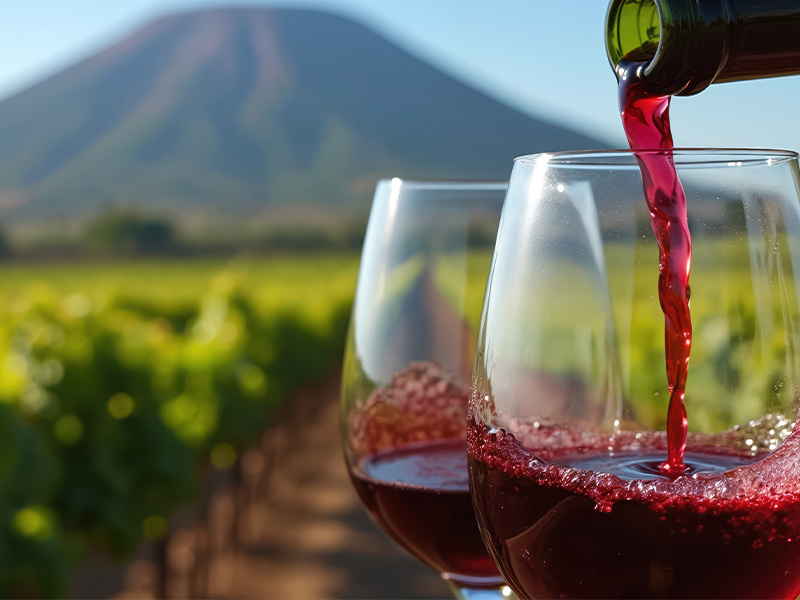
Sicily is a large, complex island set squarely in the center of the Mediterranean Sea, and for much of its history it has been less a quiet outpost and more a strategic prize.
Whoever controlled Sicily controlled trade routes, naval movement, and cultural exchange between Europe, Africa, and the Near East. Yet, while it was easily reached by sea, it was never easily unified. Mountain ranges carved the island into pockets, limiting communication between communities and allowing distinct cultures to develop side-by-side. Archaeological evidence suggests Neolithic peoples may have lived on Sicily as early as 8000 BCE, supported by cave paintings near Mount Palermo. Some scholars even speculate that these early inhabitants traveled onward to Malta, contributing to the development of megalithic temple culture around 3800 BCE. By the Bronze Age, Mycenaeans and Minoans had established trade centers such as Thapsos along the southeastern Ionian coast, tying Sicily into a wider Mediterranean network of exchange.
Around 1100 BCE, the Sicels migrated from the Italian peninsula into central and southern Sicily, adding another layer to the island’s evolving identity. By 800 BCE, Phoenicians from present-day Lebanon were developing extensive Mediterranean trade routes and established settlements along Sicily’s northwest coast near Mount Palermo. Wherever they landed, they brought agriculture and viticulture. Greek colonists soon followed, settling the eastern side near Mount Etna and Taormina, shaping the island’s cultural and agricultural trajectory in lasting ways. Around 700 BCE, the Elymians—possibly linked to North African peoples or descendants of ancient Trojans—settled in the far west. Over time, three distinct cultural groups formed: the Siculi in the east, the Sicani west of the Gela River, and the Elymians in the extreme west. Mountain barriers reinforced regional identities, and Sicily developed not as one unified culture but as a mosaic. Centuries later, the island became part of the unified nation of Italy, representing roughly 8 percent of the country’s landmass and population, though its cultural and agricultural influence far exceeds that proportion.
Geography remains the key to understanding Sicily. Positioned in the Mediterranean, the island experiences a hot, dry climate with less than 21 inches of annual rainfall—just enough for vines to survive. Intense sunshine and long growing seasons make it ideal for viticulture. Since the 1990s, producers have increasingly turned toward indigenous grape varieties and higher-quality production, often embracing organic and biodynamic practices. The island’s terrain is remarkably varied. Eastern Sicily connects geologically to the Apennines, while central and western regions contain isolated massifs. The Madonie Mountains include Pizzo Carbonara, the island’s highest peak. Rivers such as the Salso and Platani run low during summer, underscoring how dependent growers are on winter rains. African currents influence the southwestern coast, intensifying summer heat, while altitude throughout the island provides crucial cooling relief. Mountains preserve acidity and balance ripening, and sea winds reduce frost and mildew pressure, lowering the need for chemical intervention. Sicily also boasts one of the longest harvest seasons in the world, often stretching beyond 90 days.
Wind patterns shape both climate and wine style. The Ponente brings dry warmth from the west, maintaining arid conditions. Saharan winds intensify summer heat and accelerate ripening. The Maestrale, blowing from the north, moderates temperatures and preserves freshness. The Scirocco, warm and humid from the southeast, can bring rainfall when it rises along eastern slopes and cools. With limited irrigation options, growers rely heavily on rainfall, and the interplay of sun, wind, altitude, and soil defines Sicily’s distinctiveness. Nowhere is this more dramatic than on Mount Etna.
Mount Etna is often described as a wine lover’s dream, and for good reason. It combines an alpine climate within the Mediterranean, mineral-rich volcanic soils, and an unusually high concentration of ungrafted, pre-phylloxera vines. Despite Sicily’s southern latitude, elevation moderates temperatures significantly. For every 1,000 feet gained, temperatures drop roughly 3.5°C. Vineyards range from 500 to 4,000 feet, creating dramatic diurnal shifts—warm days for ripening and cool nights that preserve acidity and extend phenolic development. Steep slopes frequently require terracing and hand harvesting, increasing costs but improving quality. Cold air drains into valleys rather than lingering around vines, and south-facing slopes receive intense sunlight that can be beneficial at higher elevations. Winters can be harsh, and rainfall is relatively low, sometimes requiring irrigation.
Geologically, Etna is extraordinary. Seven of the world’s twelve soil orders are found here, the result of millennia of lava flows, ash deposits, and pumice layers. The soils are rocky, sandy, mineral-rich, and nutrient-poor, composed of decomposed lava and volcanic ash. They drain quickly and stress the vines, producing small berries with thick skins and concentrated flavors. Iron, magnesium, and phosphorus are abundant, and ideal vine pH levels allow efficient nutrient uptake. Stress, in this context, is beneficial. It limits yields and increases structure, tannin, and aging potential. White wines such as Carricante often display salinity and stony minerality, while reds like Nerello Mascalese show high acidity and firm tannins, with notes of wild strawberry, sour cherry, and red currant. Many compare Nerello Mascalese to Burgundy’s Pinot Noir for its elegance, though it retains a distinctly Sicilian edge. The sandy volcanic soils also discourage phylloxera from taking hold as aggressively as elsewhere. While Sicily suffered infestation in the 1930s, Etna preserved many ungrafted vines, some over a century old. These old vines yield less fruit, but of remarkable intensity.
At the end of the 19th century, approximately 120,000 acres surrounded Mount Etna under vine. Today, only about 2,500 acres remain. Phylloxera, economic hardship, and generational shifts dramatically reduced plantings. The Etna DOC was established in 1968, recognizing the unique arc of vineyards, from Randazzo in the north to Santa Maria di Licodia in the south. Within the DOC are “contrade,” vineyard zones comparable to French crus, shaped not only by geography but by layers of volcanic sedimentation over centuries. During the 1970s, southern Italy shifted toward bulk wine production to meet global demand for inexpensive wine, particularly from the United States. Overproduction led to the EU’s 1988 vine-pull scheme, paying growers to remove vineyards—sometimes destroying century-old plantings. By 1998, only about five producers remained on Etna.
The revival began with quality-focused producers like Giuseppe Benanti, who believed Etna could produce world-class wines. As global markets matured and sought distinctive wines beyond international varieties, Etna gained attention. Over the past two decades, vineyard area and production have steadily grown. By 2022, Etna DOC encompassed over 1,200 hectares, 442 growers, and more than 5.8 million bottles annually. In 2023, the Consorzio unanimously voted to pursue DOCG status, further recognizing the singular identity of Etna’s contrade—boundaries shaped by the volcano’s ongoing activity.
Sicily’s broader identity also rests in its native grapes. Nero d’Avola, cited as early as 1696, is the island’s flagship red, producing deeply colored wines with rich fruit, spice, and structured tannins. Nerello Mascalese, Etna’s principal red grape, thrives at elevation and produces age-worthy wines of elegance and tension. Inzolia, one of the island’s oldest whites, offers subtle aromatics and savory balance. Grillo, a cross between Catarratto and Zibibbo, produces aromatic whites with citrus, floral, and herbaceous notes, especially prevalent in Trapani. Together, these grapes reflect Sicily’s diversity and resilience.
Living beside an active volcano requires both reverence and caution. The ancient Greeks believed Etna housed Hephaestus’ forge or imprisoned the giant Typhon. Eruptions have been documented for more than 2,700 years. In 1987, Etna was designated a regional nature park to preserve its landscape and regulate development. Yet the volcano remains highly active. As recently as February 2025, eruptions sent lava across snow-covered slopes, forced airport diversions, and drew thousands of spectators despite safety warnings. Authorities imposed exclusion zones to protect onlookers from steam explosions and flying debris where lava met snow. The balance between tourism, agriculture, and safety remains delicate.
Sicily is not merely an island; it is a layered civilization shaped by conquest, migration, geology, and resilience. Its wines reflect that complexity. From ancient settlers and traders to modern revivalists, Sicily’s identity has always been dynamic. Mount Etna, in particular, embodies the tension between destruction and renewal. Volcanic soils stress vines into greatness. Old vineyards preserve history. Winds, altitude, and ash shape wines of structure and minerality. Sicily’s story is one of endurance—of cultures adapting, vineyards surviving, and winemakers rediscovering what had always been there beneath the lava and the sun.

Comments
Be the first to comment...