
Rüdger van Wyk — A New Dawn in South African Wine
- Posted on
- By Rita Allan
- Posted in Chenin Blanc, South Africa
- 0
The wine world has often told a very specific story about who wine belongs to. Historically, that story has been European, white, and rooted in centuries-old traditions that rarely made room for voices outside that culture. For many people of color entering the industry, the message was often subtle, but clear: Wine wasn’t really for you—or if it was, it belonged in sweeter, simpler, cheaper forms.
That’s what makes the story of Rüdger van Wyk so compelling.
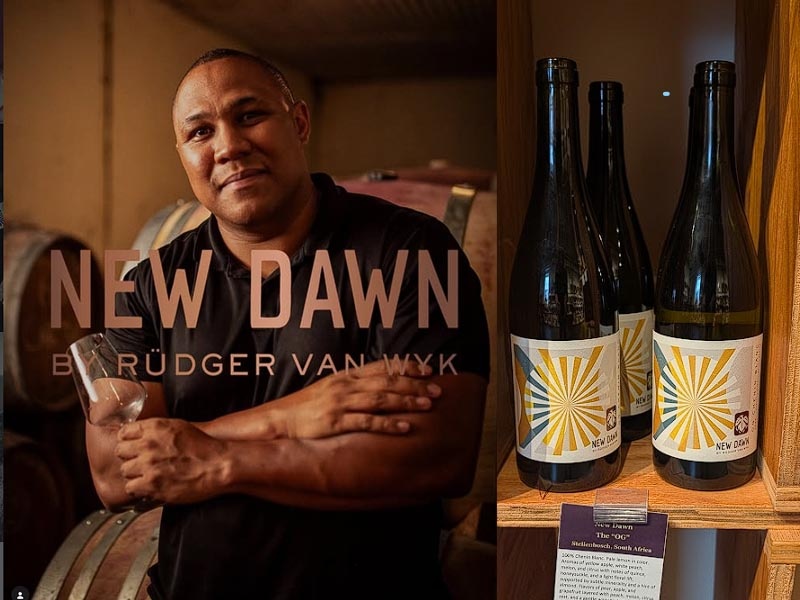
Today, Rüdger is the founder of New Dawn Wine Company in South Africa, one of the country’s most exciting emerging labels. But his story is not simply about making wine. It is about entering an industry where representation has long been uneven—and proving, bottle by bottle, that excellence speaks louder than assumptions.
To understand Rüdger’s journey, you have to understand South Africa. While the country has a Black majority, the economic reality is far more complicated. The legacy of apartheid still shapes access, land ownership, education, and opportunity. When I asked Rüdger about this, he didn’t sugarcoat it.
He told me, “South Africa is a very unique country. Yes, we have the Black majority, but economically we are in the minority. It actually still makes me sad ... where my culture still celebrates children finishing high school and going straight into the job market, when there is so much more to work for—becoming a graduate, owning a home, owning land, creating generational wealth.”
Rüdger grew up in George, along the southern coast of South Africa, hours away from the country’s famous wine regions. Wine was not part of his childhood. Swimming was. As a teenager, he trained three times a day, spending nearly five hours in the pool. I could hear him laugh through his email when telling me about his events. “I was a sprinter. 25m, 50m, 100m. Freestyle and breaststroke ... a weird combo.” But behind the laugh was something deeper. The discipline of sport would become the foundation of his career. Long before wine, he learned how to show up when nobody was watching.
He was the youngest of three brothers, and it was one of his older brothers who first introduced him to wine. His brother had become one of the earliest people of color from their community to study winemaking, taking a path that few believed possible at the time.
Rüdger told me, “Our paths were very different. There were no opportunities for him back then to get a crack in our industry. Myself, a decade later, the world changed and there were more doors to open and explore. I’m a person that doesn’t take no for an answer.”
At seventeen, he visited a winery for the first time. Towering fermentation tanks. The smell of harvest. The science, the chemistry, the transformation. Something clicked. When I asked what made him so certain about wine at such a young age, especially after watching his brother struggle—his answer came instantly: “I loooooove a challenge.”
Then I am assuming he must have smiled and continued. “I wanted to be the first to do everything in our industry as a person of colour. My friends were going into medicine, law, engineering ... I thought wine was interesting. It had science, math, accounting ... and most important: I didn’t have to sit behind a desk for eight hours and be miserable.”
That mindset brought him to Stellenbosch University, the intellectual heart of South African wine and a place deeply connected to the country’s racial history. Apartheid officially ended in 1994. That is not ancient history. That is one generation.
Rüdger admitted that the pressure was real. “There were definite social pressures at times. Stellenbosch has a strong history and culture, and I often felt I had to prove that I belonged there. It pushed me to work harder and stay focused on my goals.”
Yet even while acknowledging the scars of the past, he also speaks with hope. “My baby boys don’t see color. Some of their best friends are Caucasian, and vice versa. That was the same with me growing up. What makes it sad is when you grow up, you get exposed by the system to believe certain bias. I think it will take another generation to move on.”
That perseverance eventually earned him a place in the prestigious Cape Winemakers Guild Protégé Programme, where he trained under some of South Africa’s best. He spent time at Kanonkop Estate with Abrie Beeslaar, where the message was simple: “Excellence, excellence, excellence.”
Later, while working at Stark-Condé Wines, Rüdger began building an international reputation. Yet even as his wines earned awards, he often found himself underestimated. “There were moments where assumptions were made about me before people understood my skills or experience. There was a certain stigma to how a winemaker or farm manager should look, act, and dress in South Africa. I sometimes had to work twice as hard to be taken seriously ... but those challenges built resilience and confidence.” At wine shows, people often assumed he was there to fetch ice or pour samples, not the person who actually made the wine. And still, he kept showing up.
In 2024, after nearly a decade of building other people’s brands, he launched his own: New Dawn. When I asked if he sees himself as part of a larger movement for change in South African wine, his answer was classic Rüdger — humble, grounded, focused. “A few people have mentioned it. I believe I have to keep my head down, work hard, and be an example for my kids firstly ... and secondly inspire younger people to go out and do the same—or even more.”
But the most powerful moment of our conversation came when I asked about his parents. Who inspired him most? The following was his answer. “My late father. The vision he had to guide me to where I am today ... to endure everything he had to go through to give his boys a better life, I take my hat off to him. As a father myself now ...” Then he took a few lines down and added: “Don’t worry ... he was a whiskey drinker.”
One last question that I got in before the end of my email interview. Your parents seemed to be forward thinkers before the end of Apartheid. It is intriguing that they instilled in you that education is the key for reconciliation. There is an elegance in meekness. Moreover, they sought a better civilization and societal conditions with the pressures of hate and violence just outside your front door. Obviously, they delt with a higher hurdle. What fuelled their pursuit vs. being overcome with “This is the way it is!”?
His response caught even him off guard. “Love this question ... This is the first time anyone has ever asked me this. Not going to lie, as I’m typing this, there’s a few tears rolling down my cheeks.”
Then he wrote: “I’m so grateful for them ... What they gave me, I cannot thank them enough. I think they wanted to give me a better life than they had. And with that, I now have the responsibility to give my kids more—just to respect what my parents did for me.”
And perhaps that is what New Dawn really is. Not just a winery. Not just a brand. But a promise kept. Thanks, Rüdger for sharing your thoughts with me.
Rita Allan

Comments
Be the first to comment...