
Spain's Basque Culture and Cuisine
- Posted on
- Posted in Hondarribi Beltza, Hondarribi Zuri, spain
- 0
The Basque Country, straddling northern Spain and southwestern France along the Bay of Biscay, is a region defined by contrasts that somehow resolve into coherence: Ancient language and cutting-edge cuisine, rugged fishing villages and avant-garde architecture, deep rural tradition and global culinary influence.
Long positioned at the margins of larger national narratives, Euskadi has in recent decades undergone a quiet, but powerful, cultural and economic transformation, driven in large part by food and wine. What was once a relatively isolated culinary tradition has become one of Europe’s most influential gastronomic identities, anchored by pintxos culture, Michelin-level innovation, and the resurgence of Txakoli wine as a symbol of place.
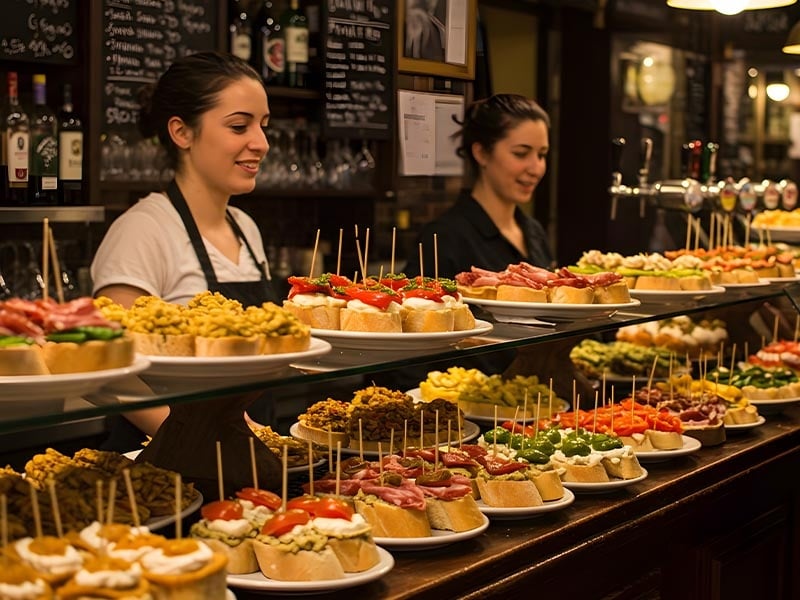
Historically, however, this reputation was far from guaranteed. For much of the 20th century, Txakoli, the region’s signature white wine was considered rustic, overly acidic, and unpolished. Produced in small quantities and consumed almost entirely locally, it functioned less as a prestige product than as an everyday table wine designed to accompany food rather than stand apart from it. As critic Pedro Ballesteros Torres MW noted, its “divine purpose” was to sharpen the appetite before the arrival of pintxos, those small bites served on bread and held together with a toothpick. The wine itself was poured from a height to introduce effervescence and soften its sharp edges, reinforcing its role as a functional, communal drink rather than a refined export.
That context has shifted dramatically. Over the past few decades, rising interest in regional European wines, combined with significant improvements in vineyard management and winemaking techniques, has repositioned Txakoli as a quality-driven expression of Atlantic terroir, rather than a rustic curiosity. New producers have refined fermentation practices, improved grape selection, and invested in better vineyard sites, producing wines with greater precision while retaining their defining freshness and saline edge. Today, Txakoli is no longer confined to local consumption but appears on international wine lists, often paired deliberately with seafood and modern Basque cuisine. Its transformation mirrors a broader regional evolution: The Basque Country is no longer culturally peripheral, but central to Spain’s culinary identity.
Geographically and culturally, Euskadi is often understood through its three major cities—San Sebastián, Bilbao, and Vitoria-Gasteiz—each contributing a distinct layer to regional identity. San Sebastián (Donostia) is the gastronomic heart, a coastal city whose elegance is matched by its extraordinary density of Michelin-starred restaurants and world-renowned pintxos culture. Bilbao, once an industrial port defined by shipyards and steel, reinvented itself through art and architecture, most famously with the Guggenheim Museum, whose titanium curves symbolize the city’s shift from manufacturing to cultural tourism. Vitoria-Gasteiz, quieter and more administrative, preserves a medieval core and functions as a reminder of the region’s deeper historical continuity. Together, these cities form a cultural triangle that reflects the Basque ability to balance tradition, reinvention, and modern identity.
Beyond the urban centers, the Basque landscape plays an equally important role in shaping its food culture. The coastline is dramatic and Atlantic-facing, producing a maritime cuisine rooted in fishing villages like Hondarribia and Getaria, where seafood remains central to both daily life and culinary heritage. Inland, the landscape becomes greener and more agricultural, supporting cider orchards, dairy farming, and vineyards. This geography produces a cuisine deeply tied to place: Seafood stews like marmitako and ttoro reflect the ocean, while inland dish es such as porrusalda and Tolosa beans reflect the pastoral interior. Even the iconic Basque cheesecake, with its caramelized exterior and soft interior, speaks to a culinary philosophy that values simplicity, texture, and depth over ornamentation.
Food in the Basque Country is not simply consumption, but ritualized social behavior. The pintxos culture, particularly in San Sebastián’s Old Town, is structured around txikiteo, the practice of moving from bar to bar, sampling small dishes accompanied by wine or Txakoli. This creates a rhythm of informal social interaction where food becomes a shared language rather than a formal dining experience. Alongside this public culture exists the more private world of txokos, or gastronomic societies, where members cook collectively, experiment with recipes, and socialize over meals. Historically male-dominated and often closed to outsiders, many txokos played an important cultural role during periods of political repression, quietly preserving language, culinary knowledge, and social cohesion. Today, they remain a distinctive feature of Basque culinary life, blending tradition with evolving social norms.
Underlying all of this is Euskera, the Basque language, which remains one of Europe’s most linguistically unique systems. It is not related to any other known language, making it an isolate and one of the oldest surviving linguistic traditions on the continent. Despite historical suppression and the dominance of Spanish and French in surrounding regions, Euskera has experienced a significant revival in the modern era. Standardization efforts such as Euskara Batua have enabled its use in education, media, and public administration, ensuring its transmission to younger generations. Government campaigns and cultural symbols, including the txantxangorri (robin), reinforce its role as a living language rather than a historical artifact. In this sense, Euskera functions not only as communication but as a core marker of identity.
Cultural expression in the Basque Country extends beyond language and cuisine into performance and folklore. Festivals such as Aste Nagusia in Bilbao or San Juan in San Sebastián transform public space into arenas of collective celebration, featuring music, fireworks, and traditional dance. The euskal dantzak, or Basque dances, preserve regional choreography and symbolism, while bertsolaris, improvised oral poets, demonstrate linguistic agility and cultural memory through spontaneous verse. Often compared to freestyle rap, bertsolaritza is deeply structured, requiring mastery of rhythm, rhyme, and topical improvisation. These traditions underscore a culture that values oral expression, communal participation, and creative spontaneity.
Economically, the Basque Country has long been shaped by a balance of industry and services. While agriculture and fishing remain culturally significant, the industrial sector, particularly metallurgy, has historically driven regional development. In recent decades, however, services, tourism, and gastronomy have become increasingly important, with wine and food tourism playing a growing role in the regional economy. Txakoli production, Rioja Alavesa viticulture, and Michelin-driven culinary tourism all contribute to a premium positioning strategy that links cultural identity with economic sustainability. At the same time, cooperative business models and strong regional governance have reinforced a distinct economic identity within Spain.
Finally, Basque identity extends far beyond Europe through its global diaspora. More than 50,000 Americans claim Basque ancestry, and communities across the United States, particularly in the West, maintain cultural traditions through festivals that celebrate food, dance, and language. These events function as both cultural preservation and reinvention, introducing Basque identity to new audiences while maintaining connections to ancestral roots. In these contexts, Euskera, traditional cuisine, and communal celebration become portable expressions of identity rather than geographically fixed traditions.
Ultimately, the Basque Country is best understood not as a static cultural region, but as a system in motion. Its identity is continuously negotiated through language revival, culinary innovation, economic adaptation, and diaspora engagement. What makes it distinctive is not simply its traditions, but its ability to evolve them without severing their roots. From Txakoli poured in coastal bars to avant-garde tasting menus in San Sebastián, from improvised bertso verses to the quiet persistence of Euskera in classrooms, the Basque Country demonstrates how culture can remain both ancient and forward-looking at the same time.
It is, in the end, a place where fermentation is not just a process in the glass, but a metaphor for culture itself: slow, responsive, shaped by environment, and always becoming something slightly more complex than what came before.

Comments
Be the first to comment...