
Boxwood and Virginia Wine: 250 Years in the Making
- Posted on
- By Rita Allan
- Posted in Sauvignon Blanc, sauvingon Gris, virgnia
- 0
Virginia wine has enjoyed a remarkable run of international recognition over the past several years. Most recently, wineries from the Commonwealth, particularly those in the Monticello AVA, made headlines after blind tastings once again placed Virginia wines alongside some of France’s best. For many, it felt like another “Judgment of Paris.” Whether it surprised anyone depended largely on which side of the Atlantic they were standing.
As the United States is now 250 years old, it also seems fitting to reflect on one of the country’s oldest wine regions. Virginia’s wine story stretches back to the earliest colonial days, and while today’s industry is still relatively young by global standards, it has become one of America’s most exciting places to grow and make wine.
Yet despite the accolades, Virginia wineries continue to face a different challenge at home. Walk into restaurants in Napa Valley or Oregon’s Willamette Valley and local wines dominate the lists. In Virginia, however, local wines are still surprisingly absent from many restaurant menus and retail shelves.
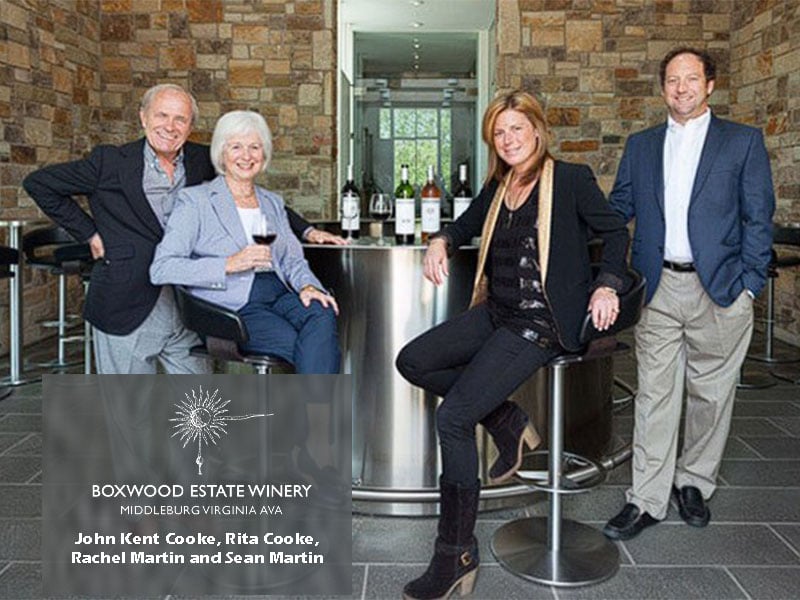
To better understand both the opportunities and challenges facing Virginia wine, I corresponded with Sean Martin, Vice President of Boxwood Estate Winery. Boxwood has long been one of Virginia’s benchmark wineries, but its influence extends well beyond the wines in the bottle. The Martin family spearheaded the effort to establish the Middleburg AVA, helping define one of Virginia’s most distinctive wine-growing regions.
Virginia wines continue to earn international recognition, yet they’re still fighting for shelf space and restaurant placements closer to home. Why is that?
It’s an uphill battle for sure. but I’m not sure it’s fair to compare those areas to Virginia. Napa has been making high-quality wine for decades and is 47,000 acres alone. Willamette Valley contains roughly 27,00-33,000 acres. They produce top wines and 71 percent of Oregon’s Pinot Noir, and they have been doing so for decades.
Virginia’s total acres under vine are 4,000. We have been making great wine for maybe 15 years. Recently I do feel we are turning a corner, with many international publications raving about Virginia wines and many wines scoring extremely high. For example, my 2024 Gris reviewed by James Suckling, scored 91 points and has consistently scored in the 90s every vintage. Spectator recently had a great article calling Charlottesville the next Napa. But it will take more time, very good salesmanship by businesses like yours and mine, consistent promotion and continued excellent winemaking. One of the other issues is that many Virginia wineries are not producing enough wine to be price-competitive. The market sometimes has ways of changing those outcomes with consolidation and competition. Virginia wine should be sold like any local product. This is a farm-to-table sale. Boxwood, locally made wine, connects the local agriculture directly to your glass, emphasizing a sustainable, estate-grown product that delivers every time.
Do you see Virginia’s diversity of grape varieties as one of its greatest strengths?
Yes!! Virginia doesn’t have a single signature grape in the way Oregon has Pinot Noir or New Zealand has Sauvignon Blanc. I don’t feel that matters. Italy, the number one seller of wine in the world, produces 1300 grape varietals.
Are there other varieties that particularly excite you for Virginia’s future?
I am excited for Virginia’s future in wine quality and agritourism. I get excited when a winemaker produces a wine I like. Not sure it has to be a specific variety.
Looking ahead, where do you see the greatest opportunity for Virginia wine? Export markets, broader distribution, agritourism, or simply convincing more Virginians to drink Virginia wine?
Greatest opportunity is to continue working hard to make a high-quality product at a competitive price. Mid-Atlantic distribution, agritourism and convincing more people in the DMV to drink more Virginia wine
If you could correct one misconception about Virginia wine, what would it be?
Virginia wine is well accepted by tens of thousands of people who visit our wineries every year; those who have not are missing out. The misconception stems from closed-mindedness, and I wish they would understand that this is a local product and business they should support.
Virginia's future may still be unfolding, but Boxwood has already played a significant role in shaping one of the Commonwealth’s most important wine regions. Boxwood spent years working with the USDA to establish the Middleburg AVA. What motivated that effort?
The Middleburg AVA (American Viticultural Area) in Virginia is home to 200 square miles in Loudoun and Fauquier Counties, and in 2012 was the seventh AVA established in Virginia. Boxwood Winery initiated the six-year petition process to establish Middleburg as an AVA in 2006. Located about 50 miles west of Washington, D.C., and surrounded by the Blue Ridge Mountains and Potomac River. Motivation to establish the AVA was to showcase quality and define the fruit’s origin. Our model started and continues to be 100 percent estate.
What was the petition process like, and who helped make it happen?
The process was grueling, like writing a doctoral thesis. Rachel Martin, my sister, wrote it, and I, my mother and John Kent Cooke (step father) edited it. No other vineyards were involved in writing it. A Virginia Tech geology professor, Lucy Morton, and a few others, were involved in the final submission.
Looking back more than a decade later, has the AVA accomplished what you hoped?
I think people that know wine understand what the AVA means and certainly professional critics do. Yes, it is something we are very proud to have accomplished.
Do visitors come specifically because they recognize the AVA, or do they discover it through tourism first?
Most visitors come to taste the wine and see our unique winery, driven by a multitude of factors, including the AVA.
For the Martin family, building a wine region wasn’t simply about geography. It was also about creating a winery that reflected their philosophy about wine itself.
I’ve visited Boxwood before, and one aspect that has always stayed with me is the winery itself. The building, designed by Hugh Jacobsen, has been described as treating winemaking as “sacred,” even incorporating a cruciform layout. That struck me as an unusual and beautiful way to think about a winery. What did Jacobsen mean by describing winemaking as sacred, and what does that philosophy mean to Boxwood today?
The winery, designed for John Kent Cooke, is our church. It is a cross and our shining star. It is sacred to our family. We cherish wine and its history. The winery was made with the highest quality materials and designed to produce the highest quality Virginia Bordeaux blends possible.
Sustainability means different things to different wineries. What does it mean at Boxwood?
The Boxwood Estate Vineyard boasts the tightest planting on the East Coast. The 26-acre sustainable vineyard blankets the slopes of this historic farmland at its highest elevation. Every vine and grape is treated with tenderness and respect, producing elegant wines with depth, complexity and finesse. We are 100 percent, estate and have a very low carbon footprint. We use drones to spray most of our vineyard and use the least harmful chemicals on our crop to maintain healthy soils and vines. We have a full-time crew and perform many vineyard tasks by hand. We are also very conscious of our neighbors and communicate with them as the vintage progresses.
What farming practices are most important to your philosophy, and do you think Virginia will eventually adopt a recognized sustainability certification?
We use a minimalist approach to our vineyard and winemaking, letting the terroir drive the outcome of the fruit. I am not sure if Virginia will adopt a certification, but I would favor it as long as science drives the outcome without politics.
Has Virginia’s changing climate influenced the way you farm compared with twenty years ago?
Many things have influenced the way we farm today, including the warming climate. More experience handling the multitude of issues that consistently present headwinds each vintage has allowed us to be more successful over time
While Boxwood built its reputation on Bordeaux-inspired blends, one of its most distinctive wines comes from a grape that many wine drinkers have never encountered: Sauvignon Gris. City Vino has a Wine Cru (club). These people have a joy of learning about obscure wine with me. The Boxwood Sauvignon Gris was a standout! It was also good timing as it was apart of the June 2026 Wine Cru package.
Why Sauvignon Gris? What convinced Boxwood to plant Sauvignon Gris in the first place?
Our winery’s focus is making Bordeaux blends, and in that light, we wanted to make a White Bordeaux. These wines typically use Semillon or Sauvignon Gris as the blending grape with Sauvignon Blanc. So, naturally, we discussed our options, including soils, vineyard planting, and vineyard expansion, and our wine consultant, Stephane Derenoncourt, recommended Sauvignon Gris. He believed the climate and our soils in Virginia were more suitable for the grape than for Semillon. Thus, the blend, Cupola, was introduced in 2019 as our new white wine (75 percent Blanc 25 percent Gris). We loved the Sauvignon Gris so much that we ended up using it as a single-varietal wine from the same vintage.
What characteristics of your vineyard make Sauvignon Gris thrive?
The rich clay soils hold a ton of moisture. Silt Loam with Gneiss, Schist, and Granite bedrock. D-Block, located at the highest elevation of the vineyard, is planted exclusively with Sauvignon Blanc and Sauvignon Gris on a northwest-southeast exposure.
Sauvignon Blanc is usually associated with cooler climates. Is the same true for Sauvignon Gris?
Sauvignon Blanc is grown all over the world, in cooler climates and some warm climates. Napa, Sonoma, Central Coast and Clarksburg, California, for example. Same goes for the Sauvignon Gris! The warmer climate changes the character of the grape during ripening but both varieties do well in Virginia.
From your experience, how does Sauvignon Gris compare with Sauvignon Blanc in the vineyard?
The Gris is a mutation of the blanc and mostly mirrors the Blanc’s path from flower to ripening during the growing season. The Blanc historically starts flowering first, just a day or two ahead. Both are equally susceptible to early frost, disease, downy mildew and insects, and their growth rates are also similar. The biggest challenge in the vineyard for both is keeping up with canopy growth, weeds, weather and labor management. The strength of the gris is the unique flavors and weight it brings to your glass.
Virginia weather changes dramatically from vintage to vintage. How much does Sauvignon Gris change each year?
Just like any varietal we grow, Gris reacts similarly to the weather variation. The hotter the vintage, the riper the fruit and thus the richer and weightier the wine becomes. We make wine with the most minimal approach possible letting the vintage dictate the outcome. The 2024 vintage is a very good example.
When harvest approaches, what tells you it’s time to pick?
Taste!
After working with Sauvignon Gris for so many years, what has surprised you most?
The complexity of flavors and its long finish.
If you were planting a new Virginia vineyard today, would Sauvignon Gris still make the cut?
Absolutely!
Do you ever sell the fruit, or is it reserved exclusively for Boxwood?
Boxwood never sells its fruit to other wineries; however, we do sell shiners for private labeling.
Growing exceptional fruit is only part of the story. Once the grapes arrive at the winery, Boxwood’s approach is to preserve the character of the vineyard rather than reshape it.
The grapes are harvested by hand, destemmed and hand sorted at the press pad adjoining the chai. Whole berries are then transferred to the press (a cylinder bladder press that gently squeezes the fruit to collect the juice), and then fermented in stainless steel tanks in our chai. The wine is then treated by microbial filter and cold stabilized. Fermentation is monitored by TankNet, a temperature control and fermentation information system
What led Boxwood toward its current winemaking philosophy?
Our current winemaker, Steven Rigby, and wine consultant, Stephane Derenoncourt, have developed our approach over time.
Have you experimented with different production methods over the years?
No.
Compared with Sauvignon Blanc, does Sauvignon Gris require a different approach in the cellar?
No.
Does Sauvignon Gris age or evolve differently than Sauvignon Blanc?
Both the Gris and the Blanc evolve differently. Both in my opinion, age extremely well in the bottle. I like to wait six months to a year before releasing, if possible. The aromas become stronger and the wine’s taste profile becomes more distinct with age.
Is it especially susceptible to oxidation?
I don’t believe so! The biggest issues in my opinion with oxidation happen because the bottling process lacks consistency with the fill or cork quality.
To bring us full circle, Virginia remains one of America's most exciting emerging wine regions. Unlike Oregon with Pinot Noir or New Zealand with Sauvignon Blanc, Virginia isn't defined by a single signature grape. Instead, we ask consumers to discover dozens of varieties, often introducing them to grapes they've never heard of or encouraging them to choose a Virginia bottle over a familiar counterpart from somewhere else in the world. That can be a challenge, but it's also one of Virginia's greatest strengths. As a retailer, I've found that the most persuasive sales tool isn't a score or a shelf talker, it's genuine experience. When someone asks, "What's this wine like?" they're looking for more than tasting notes. They're looking for confidence, enthusiasm, and a reason to take home a bottle.
When you open a bottle of Boxwood Sauvignon Gris, what do you experience, and what would you serve alongside it to convince someone to give it a try?
The wine's aromas deliver concentrated fruit and complexity with a long finish. It pairs great with Dover sole and caviar.
As America celebrates 250 years of history, it's fitting to remember that Virginia has been part of the nation's wine story since the very beginning. The earliest colonists dreamed of establishing a thriving wine industry here, though they never realized that vision. Centuries later, wineries like Boxwood are helping fulfill it, not by chasing trends, but by focusing on quality, stewardship of the land, and wines that express a true sense of place.
After corresponding with Sean Martin, one thing becomes clear: Virginia's wine industry isn't asking for special treatment. It simply wants to be judged by what's in the glass. The awards, critical acclaim, and growing international recognition suggest that day is coming. Until then, producers like Boxwood will continue doing what they've always done: investing in their vineyards, refining their craft, and inviting people to discover what Virginia wine has become. If Virginia's first 250 years were about proving wine could be grown here, the next chapter may be about proving just how exceptional it can be.

Comments
Be the first to comment...