

Sheep, Shenanigans & Shiraz: The slightly unruly history of McLaren Vale
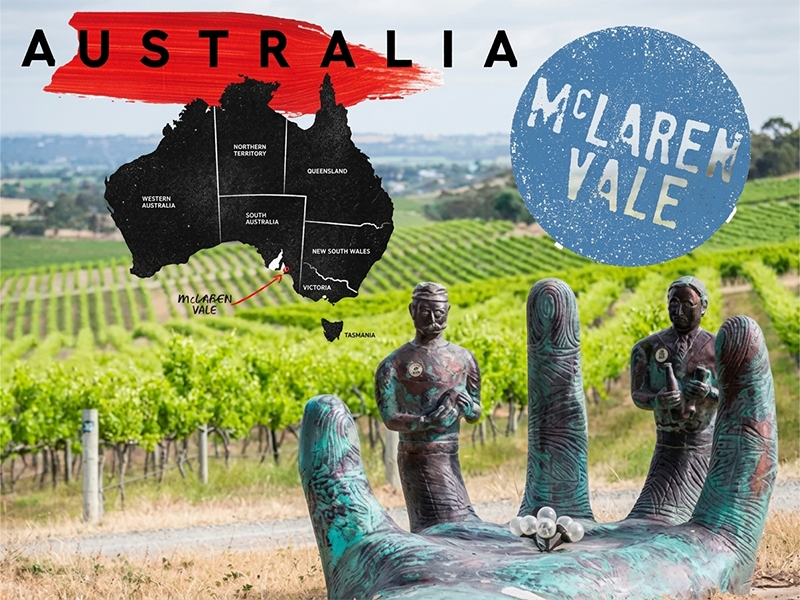
A tiny bit of the much larger Australian wine history, which I hope will help make sense as we dive into the particulars of McLaren Vale. Think Age of Discovery. You’ve got sailing ships running around the world, “discovering” new lands, establishing colonies, and generally making a very large mess of the map.
Britain had a rather large problem on its hands: convicts. They had a lot of them, and one solution was to send them very, very far away and establish a colony. In 1788, the First Fleet arrived in New South Wales. Along the way, they stopped at Rio de Janeiro and the Cape of Good Hope, and grapevines and vine cuttings made their way to Australia. The first attempts at growing grapes were largely unsuccessful. Australia was a new environment, and nobody had exactly figured out what they were doing yet.
But the British had a reason to keep trying. Britain imported a tremendous amount of wine, particularly from France, which, for reasons, they didn’t really want to rely on that country for. There was an obvious appeal in producing wine within the empire (like Virginia but that didn’t really work out) rather than depending so heavily on European (aka French) suppliers.
By 1822, men such as Gregory Blaxland, John Macarthur and William Macarthur had made enough progress to demonstrate that Australia could actually produce wine worth exporting. These early Australian wines were being fortified with approximately 10% brandy. Why? Well, you are making wine on the other side of the world and then putting it on a sailing ship for a very long journey. Fortification helped preserve and stabilize the wine during that journey. And Britain already knew what fortified wine was all about. The British liked it. And that matters.
Ok, so let us power through a few dates and events.
1836 – 1859 The First Vines
As New South Wales, on the east coast, was being populated by the British as a penal colony dumping ground, other Europeans were arriving under different circumstances. The Free Settlers, as they were called, headed inland to what is now South Australia. And yes, the state’s name is a bit confusing when putting a wine label together: “state, country” where it is “South Australia, Australia.” Microsoft Word has issues with that too. There were Germans who settled in Barossa Valley and Adelaide Hills, north of Adelaide, where it is cool enough to grow a bit of Riesling, something from home. And, later the Italians came, but we will get to that.
By 1836 South Australia had been established as a new colony. Much of the early landscape was cattle grazing, wheat and barley, and settlers figuring out how to make a living in a brand-new colony.
John Reynell was accredited with planting the first commercial vineyard in South Australia at Reynella Farms in Surryville, near Hurtle Vale in 1839 at Reynella Farm. His first vintage would not be until 1841. Others followed, like George Manning, who established Hope Farm on a 161-acre property north of Bellevue and Gloucester. Manning got his first clippings from Reverend Thomas Quinton Stow. Apparently even the Reverend was getting in on the grape-growing business. Manning kept expanding his property and growing other things like barley, but vine grapes were just more profitable.
Down in Adelaide, there was a vine nursery that supplied cuttings. Their supplies were from the sailing ships and steamers that would regularly come into port, dropping off more colonists.
Then came Thomas Hardy. After working with Reynell, Hardy planted Shiraz in 1854, made his first wine in 1857 and, in 1859, shipped two hogsheads of wine to England. Two hogsheads. Not exactly an international wine empire, but it was the beginning of Australian wine becoming an export business.
1860s The Industry Starts Getting Serious
By the early 1860s, Hope Farms was in full production, although inter colonial customs and tariffs designed to protect the wine industries in Victoria and New South Wales made commerce difficult.
In 1862, Manning’s winery produced 1,500 gallons. It just took off. By 1865, it produced 14,000 gallons with more than half coming from McLaren Vale’s growers and the continuing expansion of Hope Farm.
Production technology improved with Alexander Charles Kelly. In 1862 Kelly established Tintara vineyards Company and built Upper Tintara Cellars using a gravity flow concept. Grapes entered the winery on the top floor, were crushed, dripped down for pressing, and flowed down into barrels for gaining… you get the idea. That became the model idea for other McLaren Vale wineries like Wirra Wirra and Kay Brother.
Also, another, maybe not totally new concept, picking the fruit just a touch early which reduce the risk of excessive heat, higher yield and, at that time, winemakers considered them more favorable for fermenting. What were they fermenting? McLaren Vale and Barossa’s vineyards mainly grew (and crafted their wine in this cepage) 50% Grenache, 25% Mataro (Mourvèdre) and 25% Carignan. Scyras (Shiraz) might be a dab for color and tannin, much like Bordeaux uses Petit Verdot. Cabernet Sauvignon might also be planted but performance was variable. (they picked early… Cab Sauv would have needed more time!) Choices!
In 1866, Hardy entered into an agreement to purchase fruit from Manning. The arrangement lasted until 1891 when Manning’s Hope Farms was sold. But at least Manning had a dependable buyer for production.
1870 - 1880 Expansion, Innovation and a New Threat
As the 1870s came on, South Australia had new problems, the first was overcropping. Too many vineyards and not enough wine buyers as the wheat and barely fields were converted to vineyards. It took a tool soil quality, fertility and yields.
The other problem was phylloxera. The South Australian government rolled out progressively more restrictive legislation over the next 20 years. In 1874, the government passed the Vines Protection Act, which allowed restrictions on the importation of vines and clippings. In 1878, inspectors were added to this legislation to inspect infected vineyards. In 1885, the Vine, Fruit, and Vegetable Protection Act expanded to control plant diseases and the movement of plant material into South Australia. By 1899, importation of vines was prohibited under the Phylloxera board.
1890s Wine Goes to England
While vineyards were trying to right themselves, it caused a slight depression from the over yields. In an effort to help, a push was developed for export markets, particularly England.
Peter Bond Burgoyne exported 123,658 gallons to England in 1890. Tintara had become the most recognized and most important by 1893. His red blend was promoted as mature, full-bodied, and rich. Burgoyne was not shy about describing his South Australian competitors as “poor, vapid, characterless liquids”. It stung the other South Australian producers like Yalumba, Penfold, Thomas Hardy, Seppelt, and Buring & Sobels.
But the criticism prompted the producers to step up quality. The export marked was beginning to influence what was planted and how the wines were made. Shiraz gained importance and plantings increased. Wineries were using the John Kelly’s “down the slope” production design allowing grapes and wine to move by gravity from crushing to storage.
Maybe this was the beginning of agrotourism. Robert Strangeway Wigley and brother bought a 100-acre farm in 1893, and named it Wirra Wirra, meaning “among the gum trees.” Bob was a first class-cricketer and thought that every vineyard needed a cricket pitch and a covered spectator stand. Wirra Wirra’s main market was UK with barrels of Grenache based wine.
McLean Vale was well down the path of producing wine for a demanding international market. Bigger, darker, more tannic wines like Shiraz seemed to be the prevailing desire. That and wine with sophistication was driving the exports sales.
1900–1919 Fortified Wine, War and Spanish Flu
John Reynell’s grandson, Carew stayed in the business. Carew teamed up with Gordon Cox to create Jericho Vineyards in 1913. This was a vineyard around Reynell that was roughly 500 acers by the time all the planting was completed in 1914.
Then came World War I. Reynell was a prominent member of the wine growing community. He was also a part-time soldier who served in Gallipoli. There were no guarantees of safety in times of war. Reynell returned home in a box after having led a foot charge on Hill 60. Other soldiers, who were at least alive, started returning home from war between 1917 and the end of the war 1919.
The other major panic about here the pneumonic influenza pandemic, known as Spanish Flu, which infected about a third of Australia’s population and killed nearly 15,000 people. If Australia’s soldiers survived war, they may not have survived the flu. In a particular recording of Dulcie Rosa Christie’s diary during the pandemic, she recorded her brother Tom's death from influenza in Cairo in December 1918, the arrival of Spanish Flu in South Australia on January 29, 1919, and the first death in McLaren Vale a week later. It is an unusually personal record of a global event playing out in a wine-growing community.
1920 – 1950 The Fortified-Wine Era
The 1920s brought strong growth in the Australian wine export market. The British had enjoyed large quantities of dry red wine. But as any good market research will do it poke holes into seeing what else can be elevated in sales. Portugal’s port style was still all the rave. In 1924 the Export Bounty Act came about to encourage the export production of inexpensive fortified wines to compete for market share. The subsidy was a double edge sword as producers responded by crafting fortified wines in abundance. The initiative definitely reshaping the industry as fortified wines would dominate production for decades.
In 1948, William Benjamin “Ben” Chaffey of the Emu Wine Company and his friend Alan Ferguson bought the historic Hope Vineyards in McLaren Vale from Geoffrey Kay. Both had served in the Royal Australian Air Force during the war.
The 1950s began to look different with three significant changes. The first was the concept of bottling wine. I know right? We take this for granted that we go to a shop. But before actual bottles people brought their own containers and paid for portions granted. The region was moving from anonymous bulk wine to identifiable winery’s bottles complete with vineyard label.
The second is the concept of a cellar door. Which, at first, was actual the entrance to a winery’s cellar. The door to the cellar. A customer would literally knock-to-buy” at the door and the winemaker would open a big heavy door after breaking for what ever he was doing to sell a bottle or sell straight out of the barrel, ad-hoc rustic transition. This eventually morphed into a winery tasting room at the winery and then morphed again into a tasting room retail shop on Mainstreet in some local village or town.
The third change was the rise of the quality bar with fine wines. In 1951, Penfolds winemaker Max Schubert selected fruit from Honeypot Vineyard for what would become Grange, another sign that McLaren Vale fruit could contribute to serious Australian fine wine. Under his belt already was a bit of modernization and product improvement. Now he had means of offering a clear distinction from the regular swill!
The Italian immigrants settling in McLaren Vale added another layer to the regions culture with wine pairings, wine culture, and anything olive. The area’s reputation was changing upwards.
1960 – 1970 Table Wine Comes Back
A renaissance was brewing starting in the 1960s. It began with modernizing viticulture and focus more on quality. It didn’t happen overnight. You have to have a panic for wheels of change to start. Tatachilla, 1964, ceased production after being acquired by its UK distribution business, which caused a panic to the 182 growers that fed their bulk yields at below market prices.
Now where are these growers going to sell? With government assistance, the Southern Vales Cooperative was established in 1965, operating as a build cooperative model where growers pooled their fruit to protect their livelihood. The end products were bulk wine, brandy, and fortified spirts to sell to major merchants and blender across Australia.
The 1960s were when McLaren Vale began pulling itself out of the bulk-and-fortified-wine business. Doradillo crafted brandy, Pedro Ximenez, and Palominio (sherry production), and Shiraz. Coriole Vineyards was growing Italian varieties like Sangiovese, Fiano, and Montepulciano. d’Arenberg’s Red Burgundy won a competition for most popular wines. Pam Dunsford, 1969, became the first woman winemaker at Chapel Hill, breaking the all-boys club. And cousins, Gret and Roger Trott, produced the Church Block Blend that became the first nationally recognized Australian wine.
In the 1970s, the pendulum swung back to dry red wines, claiming about 40% of the wine produced. Main varietals used included Shiraz, Cabernet, and Grenache. The leading wineries to that end included Hardy’s, Kay Brothers, Tatachilla, Reynella, and d’Arenberg.
New technologies included rubber-tired tractors instead of horses. Not everyone was convinced that was better! New practices, growers stopped burning cuttings which actually went against them as powdery mildew became a vine plant issue. Other news included the consolidation and the corporatization of vineyards. Good and bad there. Overall, there was an increased interest in drinking wine and the food culture surrounding it. Prominently, the buying audience was moving away from fortified wines and moving toward big reds, which help to reverse the 1950 depression.
1980s Australia Goes Global
Feeling like the little engine that could charging up the final slope to reach the crescent, are we at the top yet? Where is that top? 1980s, here we come! The export markets to the UK, Canada, and the US were in a stride with an ever more increasing awareness of Australian wines. As for us Americans, we were also embracing Men at Work, Crocodile Dundee, and the Sidney Olympics. Australia was having a moment dancing or should I say hopping up and down right in front of us.
Grenache old vines came into their own about then as South Australia was having a bit of a drought and heat situation. But think of the middle of Spain and that’s all pretty much desert, which Grenache loves. So just leave the vine alone, don’t fortify it, don’t pick early and use it as bulk wine, just let it concentrate its goodness out here on the vine and fabulousness just happens.
The real game changer was in 1985. A group of Masters of Wines (people with way more knowledge than me) organized a trip to South Australia. A sort of gathering of information to understand what makes Australian wine so unique and to justify all the rave and to determine if it truly deserve this greatness status? Among this possie was British wine writer Janice Robinson, who brought a film crew. Who would not fan boys/girl with this idea? The most influential wine people in the world tromping all over your backyard poking and filming! 1986 was the prized year. The visit helped put Australian wine under an international microscope, and the timing was excellent. A weak Australian dollar and the quality of the 1986 vintage added fuel to the export boom.
McLaren Vale was increasingly recognized for Shiraz, Cabernet and Grenache, particularly Shiraz with a rich, substantial “middle palate.” McLaren Vale fruit was also becoming an important component of Penfolds Grange. But success brought its own problems. Australia was dealing with oversupply and falling grape prices, and the 1987 vine-pull scheme removed some old vineyards just as growers were beginning to appreciate their value.
1990–2000 Bigger Wines, Then a Change
Yes, we have arrived. Are we not luscious and beautiful and everything award winning? I’m sorry, who are you? I can’t say I remember you (20 minutes ago in the car) Australian wine had firmly established itself internationally on the global market, winning high scores for full bodied powerful, ripe fruit, firm tannins, high alcohol and substantial new American oak wines. 1994, McLaren Vale saw the release of it first $100 bottle. 1996 Clarendon Hills Astralis became the benchmark for Australian wines. And the big one 1997, McLaren Vale receive Geographical Indication status! The red carpet has been unfurled.
Once you hit the grand stage is there more? What do you focus on when you have hit your goals? There was a true question on style in the Australian red industry. Perhaps to use more French oak instead of American, tweak it that way? Perhaps a lower alcoholic softer style, tweak it that way? Maybe a fresher acidic, more aromatic tweak with a sense of the specific vineyard? In 1999 there was a slight interest spike toward water management and sustainability. McLaren Vale camped on improving water management as a where you plant your flag mission.
As climate change and water availability became bigger concerns, growers began looking again at Mediterranean varieties that could retain acidity and perform in a warm, dry climate. Vintners of the 2000s decided to reorganize efforts on those Italian vines they planted in the 1960s: Sangiovese, Fiano, Montepulciano, Vermentino, Nero d’Avola, Barbera, and Primitivo. McLaren Vale vintners were experimenting with them again as climate changes were being noticed and thought through how to deal with it. What were the wines that could naturally retain acidty and be a part of the future, that was a real question.
2010 – 2020s Place, Sustainability and the Future
By the 2010s, McLaren Vale was asking a different question. Not simply “How big can we make the wine?” Instead, is a “ What makes this place different?” The Scarce Earth project, begun in 2011, encouraged growers to investigate McLaren Vale's more than 30 different geological formations and the effects of geology, soil, elevation, slope, aspect, rainfall and distance from the coast.
In 2012, McLaren Vale became the first Australian wine region to achieve Sustainable Winegrowing certification, building on its earlier work with reclaimed water.
Climate and water remain central challenges, while urban development puts pressure on vineyard land. Legislation has been introduced to help protect the character of the region from urban sprawl.
At the same time, a new generation of producers is exploring leaner wines, old-vine Grenache, Mediterranean varieties and more specific expressions of vineyard site. And that may be the most interesting part of McLaren Vale's story.
It began with settlers planting vines in a new colony. It became a bulk-wine region, then a fortified-wine region, then an important source of Australian table wine. It helped Australia conquer export markets and became known for powerful Shiraz. Now it is looking back at its old vines, its geology, its Mediterranean climate and its sense of place, and asking what all of that can tell us about the next chapter.
McLaren Vale isn't finished becoming a wine region. With now almost 200 years of practicing to see what can be done, it’s still figuring itself out. The difference is that the rest of the world is paying attention.

Comments
Be the first to comment...